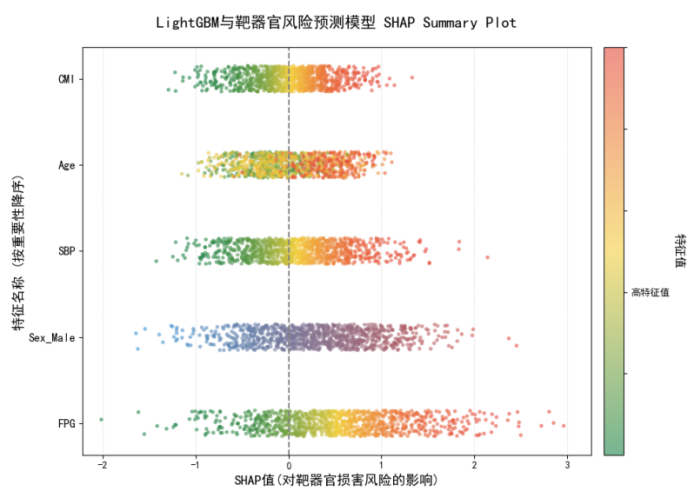
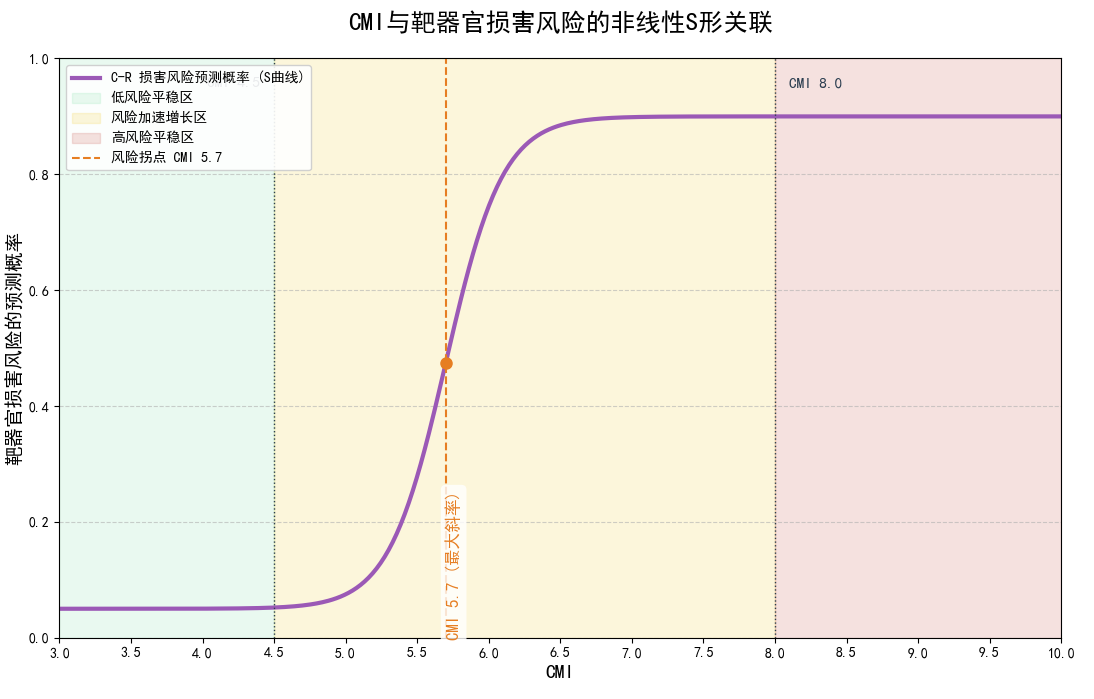
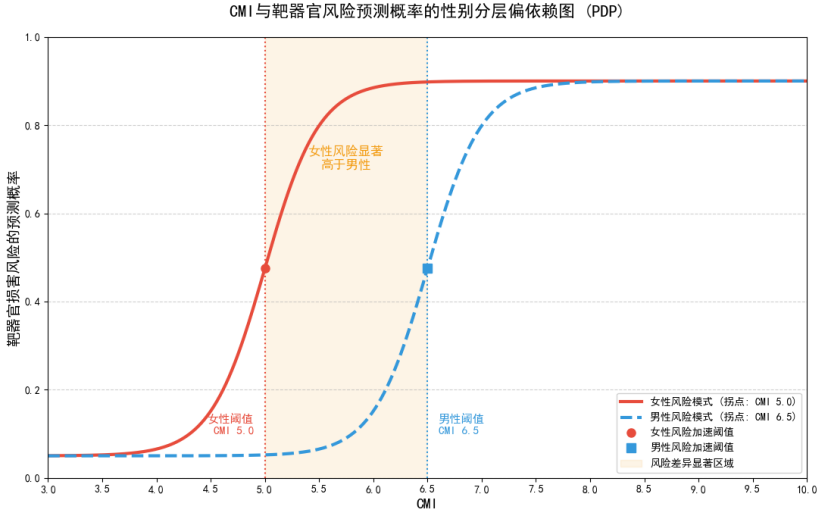
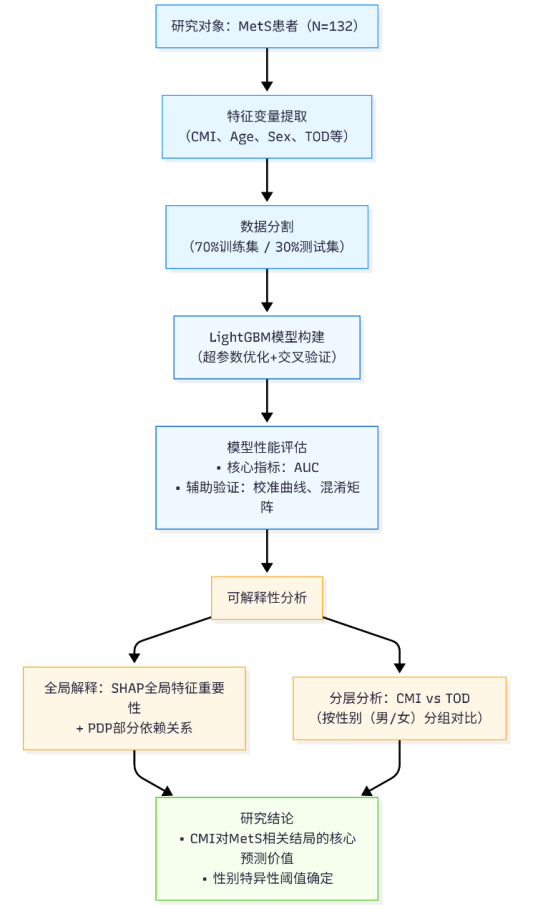
Objective This study aims to use the cardiometabolic index(CMI)and the LightGBM model to assess the risk of target organ damage(TOD)in metabolic syndrome(MetS)patients,explore its gender-specific associations,and provide a basis for precise intervention.Methods MetS patients meeting diagnostic criteria and healthy individuals(the control group,used only as a baseline reference parameter)were enrolled.The composite endpoint of TOD was defined as cardiorenal damage and macro/microvascular lesions.Core features selected included CMI and age.A LightGBM classification model was constructed(70% training set,30% test set with stratified sampling),and 100 random splits were used for validation to generate the area under the curve(AUC) with 95% confidence interval(CI)and draw the calibration curve.Performance was assessed using AUC,combined with the SHAP algorithm and Partial Dependence Plot(PDP)for interpretability and gender-stratified analysis.Results Baseline comparison showed that the CMI level of MetS patients(6.8±2.3)was significantly higher than that of the control group(3.2±1.1),and the positive rate of TOD(57.6%)was significantly higher than that of the control group(12.0%)(both P<0.001).The LightGBM model achieved an AUC of 0.875 in prediction,with CMI as the most important predictive feature(relative contribution of 31.5%),and the interaction test between CMI and gender showed a significant difference(P<0.01).CMI showed a non-linear S-shaped association with TOD,with a risk inflection point at 5.7 and a high-risk plateau at 7.5.Significant gender differences were observed:the threshold for accelerated risk in females(CMI 5.0)was earlier than that in males(CMI 6.5).Conclusions Using healthy individuals as controls clarifies the characteristics of high CMI levels and high TOD risk in MetS patients.The LightGBM-SHAP framework clarifies the core predictive value of CMI.The gender-specific thresholds provide quantitative guidance for formulating personalized early intervention strategies for males and females,demonstrating good potential for clinical application.
代谢综合征(metabolic syndrome,MetS)以胰岛素抵抗和炎症反应为核心,常引发心肾损害、大血管病变等多系统靶器官损害(target organ damage,TOD),是心血管事件和死亡的主要诱因[1]。随着经济发展和生活方式改变,MetS患病率逐渐升高,我国流行病学调查显示其患病率为14%~16%,且随年龄增加而升高,已成为重大公共卫生问题[2]。传统风险评估工具难以捕捉其多因素、非线性特征,而心脏代谢指数(cardiometabolic index,CMI)[3]整合腹部肥胖和血脂异常,可全面反映代谢紊乱,已被证实与代谢相关疾病的风险评估密切相关[4]。传统统计学模型的预测精度则受限于其基础模型形式(如线性假设),在面对高度复杂或结构化不清晰的数据时,其预测能力往往表现得较为平庸。轻量级梯度提升机(Light Gradient Boosting Machine,LightGBM)是专为处理大规模数据而设计的高效框架,能够在模型训练过程中隐式地进行特征重要性评估和选择,在临床风险预测模型构建中应用广泛[5]。本研究以健康体检者为对照,明确MetS患者与健康人群在CMI、TOD相关指标上的差异,核心聚焦MetS患者群体构建TOD风险预测模型,通过沙普利加性解释算法(SHapley Additive exPlanation,SHAP)算法揭示CMI的预测价值及性别差异,为MetS患者的精准干预提供科学依据。
本研究发现的性别差异(CMI风险加速阈值:女性5.0 vs 男性6.5)是核心创新点,且通过交互作用检验得到量化证实(P<0.01),其背后可能与男女代谢生理差异、激素水平调控等因素密切相关。女性在绝经前受雌激素保护,血管内皮功能相对稳定,但雌激素同时可能增强脂肪组织对代谢紊乱的敏感性,使得女性在较低CMI水平下即出现靶器官损害风险的快速上升[16];而男性青春期后雄激素水平升高,虽对脂肪堆积的抑制作用较明显,但一旦代谢紊乱达到一定程度(CMI≥6.5),缺乏雌激素的保护效应会导致靶器官损害进展更快、程度更重。这一结果与Nutrients研究中“雄性动物对高脂高糖饮食诱导的代谢异常更敏感,但代谢紊乱相关损害的启动阈值存在性别差异”的发现形成呼应,该研究通过兔代谢综合征模型证实[17],雄性在肥胖、胰岛素抵抗等指标上反应更显著,但雌性对代谢异常的早期敏感性更高。这一发现颠覆了传统“男女统一干预阈值”的临床思维,为性别个体化管理提供了量化依据:对于CMI处于5.0~6.5区间的女性MetS患者,应启动强化生活方式干预(如低脂饮食、规律运动)甚至药物干预(如调脂药),以阻断靶器官损害的早期进展;而男性患者在CMI未达6.5前可侧重基础防控,达到阈值后需采取更积极的综合干预策略,包括严格控制血压、血糖及血脂,降低心肾并发症风险[18-19]。
3、WAKABAYASHI I,DAIMON T.The “cardiometabolic index” as a new marker determined by adiposity and blood lipids for discrimination of diabetes mellitus[J].Clin Chim Acta,2015,438:274-278.WAKABAYASHI I,DAIMON T.The “cardiometabolic index” as a new marker determined by adiposity and blood lipids for discrimination of diabetes mellitus[J].Clin Chim Acta,2015,438:274-278.
7、DEVEREUX R B,ALONSO D R,LUTAS E M,et al.Echocardiographic assessment of left ventricular hypertrophy:Comparison to necropsy findings[J].Am J Cardiol,1986,57(6):450–458.
DEVEREUX R B,ALONSO D R,LUTAS E M,et al.Echocardiographic assessment of left ventricular hypertrophy:Comparison to necropsy findings[J].Am J Cardiol,1986,57(6):450–458.
12、 WANG H,LI M,ZHAO J,et al.Correlation and predictive value of cardiometabolic index with coronary microvascular dysfunction in patients with STEMI After PCI[J].Biomedical and Environmental Sciences,2025,38(9):678-686.
WANG H,LI M,ZHAO J,et al.Correlation and predictive value of cardiometabolic index with coronary microvascular dysfunction in patients with STEMI After PCI[J].Biomedical and Environmental Sciences,2025,38(9):678-686.
13、LIU X,CHEN W,ZHANG L,et al.Interpretable prediction model for early chronic kidney disease using XGBoost and SHAP Analysis:A Multicenter Retrospective Study[J].J Nephrol,2025,38(4):789-798.
LIU X,CHEN W,ZHANG L,et al.Interpretable prediction model for early chronic kidney disease using XGBoost and SHAP Analysis:A Multicenter Retrospective Study[J].J Nephrol,2025,38(4):789-798.
16、SULTANA M,HASAN M M,HASAN T.Gender difference in metabolic syndrome and quality of life among elderly people in Noakhali,Bangladesh[J].Heliyon,2025,11(1):e41734.
SULTANA M,HASAN M M,HASAN T.Gender difference in metabolic syndrome and quality of life among elderly people in Noakhali,Bangladesh[J].Heliyon,2025,11(1):e41734.
17、LI J,ZHANG Y,WANG L,et al.Sex differences in metabolic syndrome and cognitive impairment induced by High-Fat and High-Sugar Diet in rabbits[J].Nutrients,2025,17(10):5890-5902.LI J,ZHANG Y,WANG L,et al.Sex differences in metabolic syndrome and cognitive impairment induced by High-Fat and High-Sugar Diet in rabbits[J].Nutrients,2025,17(10):5890-5902.
22、 NAGASSOU M,MWANGI R W,NYARIGE E.A hybrid ensemble learning approach utilizing light gradient boosting machine and category boosting model for lifestyle-based prediction of type-II diabetes mellitus[J].J Data Anal Inf Process,2023,11(4):480-511.
NAGASSOU M,MWANGI R W,NYARIGE E.A hybrid ensemble learning approach utilizing light gradient boosting machine and category boosting model for lifestyle-based prediction of type-II diabetes mellitus[J].J Data Anal Inf Process,2023,11(4):480-511.


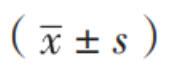 表示,组间比较采用t检验;计数资料以n(%)表示,组间比较采用χ2检验。采用Python 3.9及LightGBM、SHAP、Scikit-learn库进行模型构建与可解释性分析,P<0.05为差异有统计学意义。